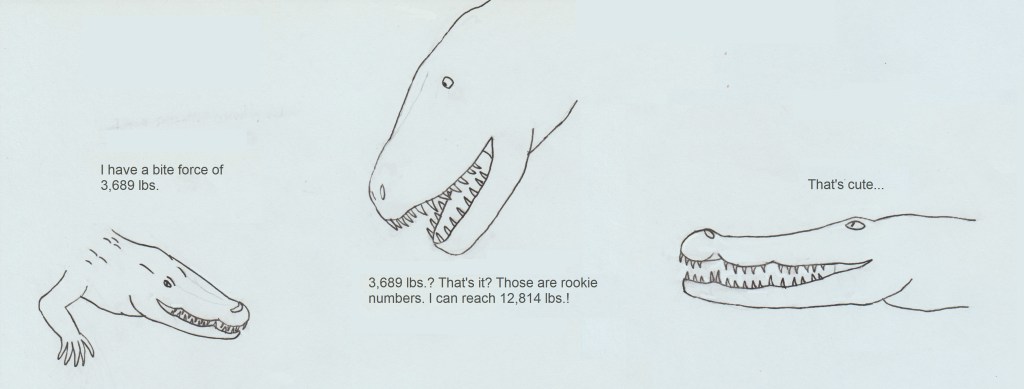
Which animal has the strongest bite? Perhaps it is a bear. These big, burly beasts surely have strong jaws, if only because of how large they are. Of course, the hyena is famous for having a bone crushing bite, so perhaps it is the hyena. Or maybe, it is the great white shark, a huge predator with an intimidating set of teeth.
Believe it or not, scientists have studied bite forces in animals. They do so because they want to understand how the jaws of predators function, how they are able to use their jaws to capture and hold prey. In case you are wondering how they measure bite force, they use a pressure plate attached to the end of a rod, and then let the animal bite down on the plate.
The highest bite force every measured for an animal was 3,689 lbs. This massive bite force was accomplished by a saltwater crocodile. To put that bite force in perspective, the hyena is the mammal with the highest measured bite force, and the strongest bite produced by a hyena is only 1,011 lbs.[1]
It turns out that among the crocodilians, which is the group that includes the crocodiles, alligators, and gavials, bite force is basically proportional to body size. That is, the larger the crocodile, the stronger the bite force. That makes sense. What is rather unexpected is that it doesn’t matter the species of alligator or crocodile. If there is an alligator and a crocodile that are the same size, their bite forces should be roughly the same.[2]
As impressive as are the bite forces of the crocodilians, we often want to know the strongest bite force ever. The one extinct animal that receives a lot of attention for its stupendous bite force is none other than Tyrannosaurus rex. And for good reason. Even though Tyrannosaurus rex is not the largest predatory dinosaur, it is certainly one of the largest. Compared to the other large theropods, Tyrannosaurus has a burlier, more powerful build. Thus, we should expect a forty foot long, powerfully built predator to have a massive bite force. Indeed, estimations of the bite force of Tyrannosaurus rex put it at a maximum bite force of 12,814 lbs.[3] That is an incredibly powerful bite that blows the bite force of the saltwater crocodile out of the water. That just goes to show how powerful the dinosaurs were. Except…
The saltwater crocodile is not the largest crocodilian. There were crocodilians much larger in the past. The largest known is Deinosuchus riograndensis. Recall that crocodilian bite force scales with size. Thus, a large crocodile, such as the forty foot long Deinosuchus riograndensis, should have a much larger bite force than a saltwater crocodile.
Before I reveal its bite force, I want to clarify a few things about Deinosuchus. First, some of you may be wondering, “But I thought Sarcosuchus was the largest crocodile. Why not give the bite for of that one?” While Sarcosuchus is a crocodile, it is not a crocodilian. While we use the term “crocodile” for a specific family of living animals, the term “crocodile” can also apply to the large group called Crocodylomorpha. The crocodilians, which is the group that includes the living crocodiles, alligators, and gavials, is just one group within the larger Crocodylomorpha. Thus, Sarcosuchus is a crocodile (belongs to Crocodylomorpha) but is it not a crocodile (does not belong to Crocodylia, the crocodilians). Since it does not belong to the same group as living crocodiles and alligators, we do not know if its bite force scales the same way. Thus, we will have to use Deinosuchus riograndensis, since it does belong to the Crocodylia group.
Second, while Deinosuchus was thought for a long time to be a crocodile, it is actually an alligator. For our purposes, it does not really matter, since all crocodilians scale to the same bite force per size. However, it is interesting to note that the largest known crocodilian is not a crocodile, it is actually a massive alligator.
Third, the bite force I will be giving is for Deinosuchus riograndensis specifically. This is the species that most people think of when they talk about the genus Deinosuchus, but Deinosuchus riograndensis is just one of three Deinosuchus species. Deinosuchus riograndensis is the largest species, and it is known from Texas and Mexico. Deinosuchus schwimmeri is smaller and it is known from Alabama and Mississippi. Deinosuchus hatcheri is known from only a little bit of material, and it is known from Montana.[4] Since we are interested in largest bite force, we will focus on the largest of the three, Deinosuchus riograndensis.
The bite force of Deinosuchus riograndensis is estimated to have been…
23,111 lbs.[5]
That is close to double the estimated maximum bite force for Tyrannosaurus rex.
Don’t get me wrong, Tyrannosaurus rex was an amazing animal, and it was probably a frightening and powerful predator. However, we sometimes let our fascination with dinosaurs get the better of us. As impressive as the dinosaurs were, there were other animals that were even more impressive, at least according to certain measurements.
Thoughts from Steven
[1]Erickson, Gregory; Paul Gignac; Scott Steppan; A. Krisopher Lappin; Kent Vliet; John Brueggen;Brian Inouye; David Kledzik; Grahame Webb (2012) “Insights into the Ecology and Evolutionary Success of Crocodilians Revealed through Bite-Force and Tooth-Pressure Experimentation” PLoS ONE 7(3): e31781
[2]Ibid.
[3]Bates, K. and P. Falkingham (2012) “Estimating maximum bite performance in Tyrannosaurus rex using multi-body dynamics” Biology Letters 8: 660-664
[4]Cossette, Adam and Crhistopher Brochu (2020) “A systematic review of the giant alligatoroid Deinosuchus from the Campanian of North America and its implications for the relationships at the root of Crocodylia” Journal of Vertebrate Paleontology e1767638
[5]Erickson, Gregory; Paul Gignac; Scott Steppan; A. Krisopher Lappin; Kent Vliet; John Brueggen;Brian Inouye; David Kledzik; Grahame Webb (2012) “Insights into the Ecology and Evolutionary Success of Crocodilians Revealed throguh Bite-Force and Tooth-Pressure Experimentation” PLoS ONE 7(3): e31781
 Heart of America Science Resource Center