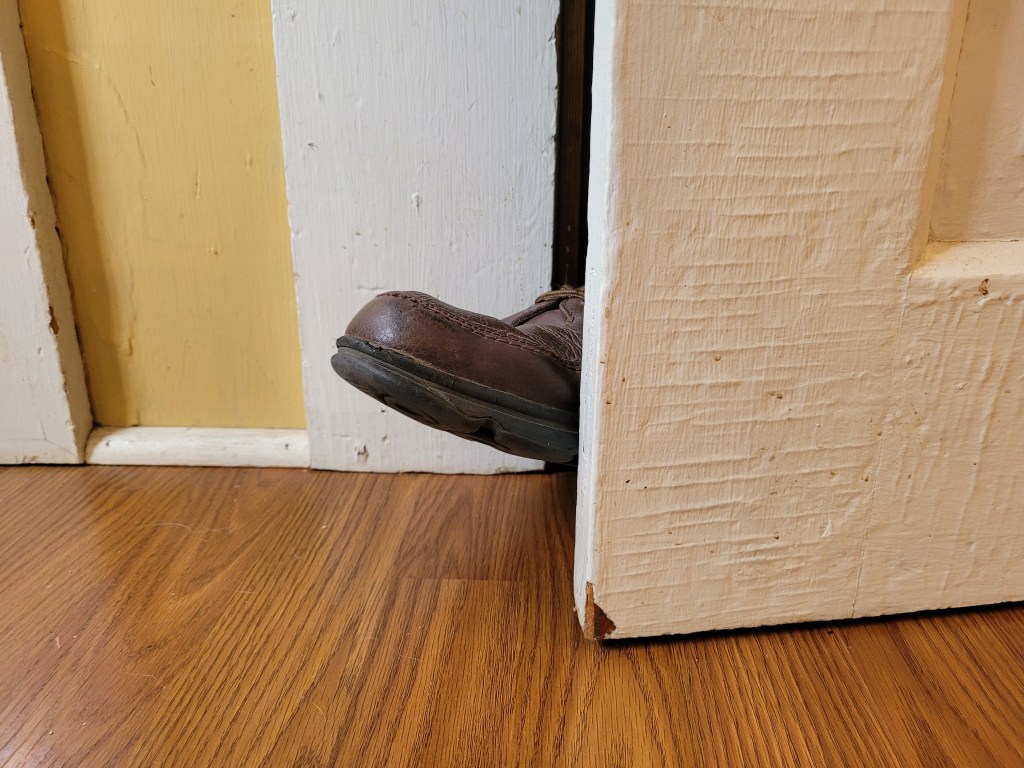
Evolutionary biologist Richard Lewontin made a rather interesting comment that has become infamous among creationists.[1] The highlight of the quote is, “Moreover, that materialism is absolute, for we cannot allow a Divine Foot in the door.” To put the quote in context, here is the paragraph that contains the quote:
Our willingness to accept scientific claims that are against common sense is the key to an understanding of the real struggle between science and the supernatural. We take the side of science in spite of the patent absurdity of some of its constructs, in spite of its failure to fulfill many of its extravagant promises of heath and life, in spite of the tolerance of the scientific community for unsubstantiated just-so-stories, because we have a prior commitment, a commitment to materialism. It is not that the methods and institutions of science somehow compel us to accept a material explanation of the phenomenal world, but, on the contrary, that we are forced by our a priori adherence to material causes to create an apparatus of investigation and a set of concepts that produce material explanations, no matter how counter-intuitive, no matter how mystifying to the uninitiated. Moreover, that materialism is absolute, for we cannot allow a Divine Foot in the door. The eminent Kant scholar Lewis Beck used to say that anyone who could believe in God could believe in anything. To appeal to an omnipotent deity is to allow that at any moment the regularities of nature may be ruptured, that miracles may happen.[2]
Some call this an amazing admission,[3] but I think it is not that revealing. Secular scientists have not been quiet about their disapproval of any supernatural explanation in science. For example, in a pamphlet titled, “Pseudoscience of Animals and Plants,” John Schrock listed twenty science attitudes. The twelfth is, “Aversion to superstition and an automatic preference for scientific explanations.”[4] Schrock does not mention “supernatural” specifically, but that would fall under his concept of “superstition.” Moreover, he gives a reason why scientists prefer scientific explanations rather than superstition: “A scientist rejects superstition and prefers science paradigms out of an appreciation for the power of reality-based knowledge.”[5]
Now, Schrock’s explanation for why scientists should reject the supernatural is weak. However, that is to be expected: his article provides a summary, a concise explanation of the attitudes of scientists. A more thorough explanation of the thought behind science is provided by Grandy and Bickmore, who wrote “Science as Storytelling.”[6] They describe science as a way to tell stories about the natural world. Just as literary genres have certain rules they must follow, such as a protagonist, an antagonist, a conflict, a climax, and a resolution, so the stories of science must follow certain rules. One of these rules is naturalism. Grandy and Bickmore give the full rule like this: “Scientific explanations do not appeal to the supernatural. Only naturalistic explanations are allowed.”[7] And, by “naturalistic,” they specifically mean “according to the laws of nature.” Unlike Schrock, Grandy and Bickmore spend three pages explaining why it is necessary for the stories of science to reject supernatural explanations. They reject supernatural explanations, not because they think the supernatural is silly, not even because they think supernatural events cannot occur, but because “supernatural explanations tend to not generate precise new predictions… Science operates by observing regularities in nature, but supernatural beings like Apollo might decide to change the natural order at any moment, and how could we predict when or why that would happen?”[8] They use the example of Apollo, because according to Greek legend, Apollo rode a chariot carrying the Sun across the sky every day. What happens if Apollo decides to take a day off? Or repair his chariot? Or drives his chariot faster than usual? Or slower? Since Apollo is not bound by natural regularities, who knows what will happen from day to day. Thus, supernatural explanations cannot be predictable and testable.
Note that Schrock and Grandy and Bickmore do not reject the supernatural because they want to avoid God. They do not shy away from the supernatural because to do so would cause them to admit a Divine Creator to whom they will be held accountable. They have practical reasons for rejecting the supernatural. They want science to rest on something testable, and the supernatural, the suspension of the natural, removes that testability.
“Ah,” some may. “That is why Lewontin’s quote is so exceptional. He admits the purpose of rejecting the supernatural is to prevent God from entering his life. After all, he says, quite plainly, ‘we cannot allow a Divine Foot in the door.'” However, this is why we needed to read the context of Lewontin’s quote. Yes, he mentions a “Divine Foot.” No, he is not saying, “Keep God away from me! I do not want to be held accountable by a righteous God!” Note what he says immediately after the “Divine Foot” quote: “The Eminent Kant Scholar Lewis Beck used to say that anyone who could believe in God could believe in anything. To appeal to an omnipotent deity is to allow that at any moment the regularities of nature may be ruptured, that miracles may happen.”[9] Does that sound familiar? It is the same argument Grandy and Bickmore made: allowing the supernatural removes regularity and predictability. The “Divine Foot” is not a specific reference to the God of the Bible, it is a reference to acceptance of any supernatural agent, an agent that can wreck havoc with nature and natural laws.
“But,” some may protest. “Lewontin must be referring to a rejection of the God of the Bible. He said that we must accept scientific claims that are against common sense, that science can be patently absurd, that science fails on its promises, that the scientific community tolerates ‘just-so’ stories. He is preventing science from reaching the conclusion that God created the universe, despite the fact that all of the evidence points to a Creator.”
To understand these parts of Lewontin’s quote, we need to understand the broader context of his article. The failures of science, the “just-so” stories, they have nothing to do with origins science. He used the war on cancer as an example. He notes that scientists have repeatedly failed to produce a cure for cancer, despite promises that a cure was just around the corner. “Just-so” stories are things like claiming that modern medicine extended the lives of people in western civilization, despite the fact that longevity began before modern medicine took effect.[10] Lewontin was not admitting to fabricating science in order to prevent God from entering the picture: he was noting the limitations of science, of practical science, in fulfilling its promises, of providing accurate stories, and so forth.
After looking at the context of Lewontin’s quote, it becomes apparent that he was not admitting anything unique or special. He may have been using language that was more allegorical than we are used to, but it is clear from the context of his article that he is not specially pleading for materialism in order to prevent God from being his personal Creator. Now, I am not agreeing with Lewontin: not by a long shot. I will be noting a fallacy in his argument in just a moment. However, before noting what that fallacy is, it is necessary to first understand exactly what he claimed. Part of understanding what he claimed is understanding what he did not claim.
Lewontin’s ultimate problem is that he elevates human reasoning above the truth of God’s Word. Regardless of how he reached his conclusion, he did decide that it was necessary to reject any supernatural causation in scientific explanations. He reached that conclusion by his own powers of reasoning and by relying on the powers of reasoning of others (for example, Lewis Black, whom he cites at the end of the quote). By rejecting the supernatural, he ultimately rejected God’s ability to intervene in the world He created. Thus, Lewontin ultimately placed his own reasoning as superior to the reasoning of God.
We know what Lewontin did wrong. Now the question is, how can we use his own words to expose a fallacy in his reasoning? It would be easy to say, “You are rejecting God’s Word, and that is why you are reaching false conclusions, such as the theory of evolution.” However, as true as that statement may be, it would do little to convict Lewontin, as he would simply laugh at the idea that he should listen to some old dusty book of miraculous stories. Remember, he has already rejected the supernatural: God and His Word mean little to him.
It might be tempting to cite some spectacular evidence that favors creationism over evolution. Maybe we could convince him with dinosaur proteins, or irreducible complexity, or the amazing design of a giraffe or woodpecker, or the billions of dead things buried in rock layers laid down by water all over the Earth. The problem with this approach is that Lewontin would outright reject our conclusion that creationism is true. Remember, he did say that materialism must be held absolutely, in spite of how silly it may seem at times. Bludgeoning him with the facts will do little to convince him if he takes those facts and filters them through the lens of materialism.
Perhaps his admission that we must admit material explanation in spite of it running against common sense, its patent absurdity, and its failure to fulfill its promises provides an opening. After all, what he is essentially admitting is that science is limited. Science fails at times, because the people who practice it have limited information. It runs against common sense at times because we are trying our best to understand a vast universe with limited human knowledge. If science is limited, then why should we trust it? If it fails at times, should we really let it guide our understanding of the universe?
This approach is better. We are actually using his own words against him, thus challenging his own claims. However, this will be a short tact, because Lewontin will probably counter with, “Despite its limitations, science is the best that we have.” There is some truth to that statement: even as a creationist, I recognize the limitations of science. It does not lead me to reject the conclusions of science, it simply reminds me to be flexible and to be ready to change my mind about scientific conclusions. In a sense, science is “the best we got.”
What we really need to do is address Lewontin’s commitment to materialism. Since he adheres to materialism in spite of the failures of science, he is not using science itself to support materialism. Rather, materialism is a conclusion drawn from a different line of reasoning. In fact, we already talked about it. He accepts materialism because if he accepts the supernatural, then regularities and testability become impossible.
Let us read what he says again. Pay close attention to his reasoning after the “Divine Foot” phrase.
Moreover, that materialism is absolute, for we cannot allow a Divine Foot in the door. The eminent Kant scholar Lewis Beck used to say that anyone who could believe in God could believe in anything. To appeal to an omnipotent deity is to allow that at any moment the regularities of nature may be ruptured, that miracles may happen.[11]
Is it accurate to think that an omnipotent deity renders regularities impossible? On the one hand, the answer seems obvious: yes, it does. After all, if a deity can interfere in the natural world on a whim, then we have no guarantee that the natural world will be regular. However…
That is only true in some situations. An arbitrary deity, who acts on whims, may render the world irregular. A deity who regularly interferes in the world may regularly disrupt natural laws. We, as Christians, worship a God with whom is no variation or shadow of change (James 1:17), a God who has had a plan for His people from before the beginning of time (Ephesians 1:3-6). We do not worship an arbitrary God, but a God who is regular and has carefully planned history. Moreover, He has assured us that the world He created will continue, with regular patterns, until the end of the world itself. After all, when He created the Sun, Moon, and stars on Day 4 of Creation Week, He specifically said that they were to be “for signs and for seasons and for days and years” (Genesis 1:14). Notice the regular patterns of time and seasons, patterns that He not only built into the universe but made measurable by the celestial bodies. He made patterns and made us capable of seeing those patterns! We again see human’s ability to understand and manipulate the natural world in the Dominion Mandate (Genesis 1:28). God reaffirmed the regularities of nature after the Flood. You know, Noah’s Flood, probably the single most significant event where God interfered in and reshaped the face of the Earth? God specifically promised not to do something like that again, and assured Noah that while “the earth remains, seedtime and harvest, cold and heat, summer and winter, day and night, shall not cease” (Genesis 8:21-22). While God certainly did intervene in the world and produce miracles since that time, miracles were notable for their rarity. They were often used as a sign of God’s power specifically because they disrupted the regular patterns of the natural world (Luke 8:22-25, noting how in verse 25, the Disciples marvel at Jesus’s power over the wind and waves). Thus, God created a world that is regular, that humans can comprehend, even though He did, and can, supersede the laws of nature.
That is Lewontin’s problem: he does not consider that possibility. He considers the existence of the supernatural to mean the absence of regularity, ignoring or overlooking the possibility of a Deity that is regular Himself and created a world with regularity to it. That is where Lewontin went wrong: he presumed too much about the nature of the supernatural.
Now, Lewontin may accuse me of special pleading. That is true, but it is also irrelevant. It is true because I am only concerned about the God of the Bible. I do not care how Apollo, Odin, Isis, Vishnu, or Allah impact the regularity of the natural world. I only care about how the God of Abraham, Isaac, and Jacob created the natural world. However, despite my special pleading, Lewontin still has to address the possibility of an unchangeable God who created a regular universe meant to be comprehensible by humans. He addressed the supernatural in broad strokes: he acted as if any omnipotent deity would render the natural world irregular and untestable. As evidenced by the God of the Bible, such is not the case. Thus, Lewontin’s presumption that any omnipotent deity would destroy testability is wrong, which means he does not have justification for restricting himself, much less all of science, to materialism.
The argument I present here may be no more convincing than simply claiming that Lewontin is rejecting God’s Word, that he is ignoring convincing science, or that he admitted to the limitations of science. My guess is that he would remain steadfast in his adherence to materialism. However, my argument attacks the chink in his armor: it addresses Lewontin’s subtle presumption, a presumption that he would need to address in order to remain consistent in his worldview. He may keep that worldview, working feverishly to fill in the chink in his armor. He may even come up with a solution, that we as creationists would have to address all over again. Nevertheless, my argument successfully challenges his presuppositions, forcing him to defend his faith and worldview. It can also enlighten those who think that Lewontin is brilliant, exposing him as a mere human who has to slog through a morass of assumptions, just like the rest of us.
Thoughts from Steven
[1]Shipley, Tom (2021) “The Frauds of Evolution #14: Divine Foot in the Door” thecreationclub.com, retrieved from https://thecreationclub.com/the-frauds-of-evolution-14-a-divine-foot-in-the-door/ on June 3, 2023 and Creager, Charles (2023) “They Will not Allow a Divine Foot in the Door” timesexaminer.com retrieved from https://www.timesexaminer.com/charles-creager-jr/10807-they-will-not-allow-a-divine-foot-in-the-door on June 3, 2023
[2]Lewontin, Richard (1997) “Billions and Billions of Demons” The New York Review, January 9, 1997, pg. 31
[3]“Amazing Admission” creation.com, retrieved from https://creation.com/amazing-admission-lewontin-quote# on June 3, 2023
[4]Schrock, John (2004) “Pseudoscience of Animals and Plants: A Teacher’s Guide to Nonscientific Beliefs” The Kansas School Naturalist 35(4): pg. 9
[5]Ibid.
[6]Grandy, David and Barry Bickmore (2014) “Science as Storytelling” BYU Studies Quarterly 53(4): Article 4
[7]Ibid.
[8]Ibid.
[9]Lewontin, Richard (1997) “Billions and Billions of Demons” The New York Review, January 9, 1997, pg. 31
[10]Ibid.
[11]Ibid.
 Heart of America Science Resource Center