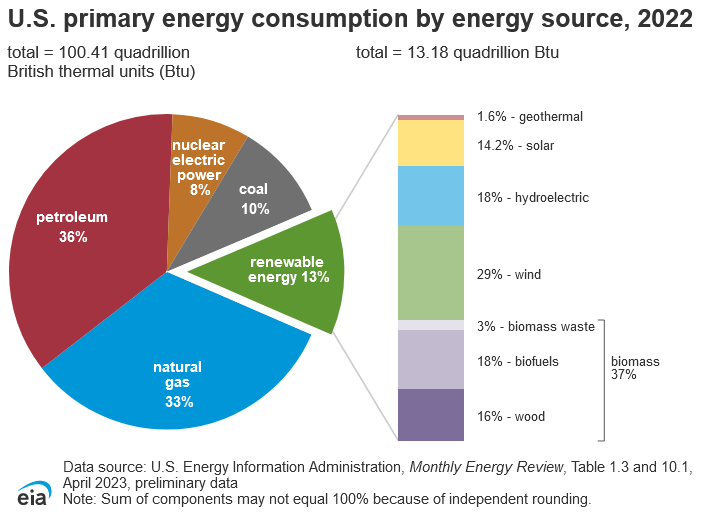
In my last post, I made a comment about how science is taught in grade school classrooms. I am going to do the same today because I have encountered another controversial topic while teaching my students.
The topic is United States energy consumption. Perhaps you have seen a chart like the one above. This chart shows the energy consumption within the United States, broken up by source of energy. Basically, it shows us where we get our energy from. The first thing you may notice is that fossil fuels (petroleum, natural gas, and coal) still dominate our energy consumption, comprising a total of 79% of all of the energy consumed in this country. The fossil fuels dominate despite the fact that we have had decades of various governments, notably state governments and the federal government, promoting renewables and discouraging fossil fuels as much as possible.
For those who may scoff and say, “State governments and the federal government do not favor renewables over fossils fuels,” it is worth being reminded that California has a ban on new combustion engine production starting in 2035,[1] the U.S. Department of Energy has a Wind Energy Technologies Office that outlines “primary federal incentives for developing and investing in wind power, resources for funding wind power, and opportunities to partner with DOE and other federal agencies on efforts to move the U.S. wind industry forward,”[2] and the Biden-Harris Administration awarded farms and ranchers $266 million for investments in renewable energy usage.[3] So there are incentives to use renewable energy and disincentives to use fossil fuels.
Guess what students in our classrooms are being taught?
Unsurprisingly, they are taught that there is a need to switch our energy production to renewable sources. What surprised me was how they reached that conclusion. Here is what my textbook says:
The main advantage to petroleum, also called crude oil, is that it is a powerful fuel. However, crude oil exists only in a limited supply. Petroleum also requires drilling to access it. The process is expensive and it damages the environment. Finally, the burning and accidental spilling of petroleum results in air pollution, land pollution, and water pollution on a vast scale.[4]
There is the obvious concern about environmental concerns (no direct mention of global warming or climate change, though), but the one that really surprised me was the concern that petroleum is in limited supply. In fact, a question found later in the book expects the students to be concerned about the problem of running out of petroleum.[5]
There is a lot that could be said about petroleum, its use, and how much it pollutes and how that compares to renewables, but I want to focus on one claim, the claim that petroleum is in limited supply and we need to switch to renewables or we will run out of energy.
It is not difficult to search for and find information about the amount of proven reserves of oil left on Earth. One website that displays this information is worldometers.info. Their information includes a countdown, with the amount of barrels of oil in the world remaining, constantly ticking down showing Earth’s oil becoming more and more depleted.[6] Let us use their information to highlight an important point about the amount of petroleum left in the world.
According to worldometers.info, in 2016, there was about 1.65 trillion barrels of proven oil reserves left in the world. The countdown meter is currently at 1.38 trillion barrels of oil and dropping. Thus, in seven years, there was been about 0.27 trillion, or 270 billion, barrels of oil consumed. At this rate, the world’s supply of petroleum will be used up 40 years from now.
Let us contrast this number, 1.65 trillion barrels, to estimates of the world reserves of oil from another source. An article in Energy Policy from 2010 contained several estimates of the proven reserves of petroleum. These estimates range from 903 to 1184 to 1241 to 1258 to 1342 billion barrels of oil.[7] First of all, note the range: there is a difference of 439 billion barrels between the highest and lowest estimates. That is a wide spread, which just highlights that these are estimates, not absolutely measured numbers. For our purposes, let us use the highest estimate, 1342 billion barrels, an estimate which was made in 2009.
In 2009, we had 1.342 trillion barrels of oil, according to the article in Energy Policy. In 2016, we had 1.65 trillion barrels of oil, according to worldometers.info. That is an increase of 310 billion barrels of oil over seven years. If the Earth has a finite amount of oil, where did those extra barrels of oil come from?
From exploration. Oil companies are constantly searching for, and sometimes finding, new locations that contain petroleum. In a span of seven years, 310 billion barrels of oil was added to the known reserves. Note that from 2016 to the present, which is also a span of seven years, we have “only” used 270 billion barrels of oil. In other words, it is entirely possible that new discoveries of oil can completely offset the amount of oil consumed.
So how limited is our supply of oil? The truth is, we do not know. Sure, the Earth is finite: it can only hold so much petroleum, in theory. However, it is likely that we have not found every drop of available oil on the planet. Thus, it is entirely possible that we have more than 40 years of petroleum left. If we consider other factors, like increased efficiency of energy usage and the ability to re-search spent oil fields and find oil that was missed or overlooked, it is entirely possible that we have far more than 40 years left of petroleum. In other words, the situation is not nearly as dire as my textbook leads one to believe.
This example highlights a problem with trying to be unbiased when teaching gradeschoolers. Information must be simplified: gradeschoolers do not know enough to make truly informed decisions. Thus, science has to be greatly simplified for them to grasp it. During that simplification, some information gets lost and what information gets lost depends on the point the teacher wants to make. Do you want students to be concerned about the dwindling supply of petroleum? Cite the current supply and projection of current consumption without explaining how new reserves of oil have been found in recent decades. Want to dismiss the concern of running out of petroleum? Highlight the discovery of new reserves of oil while glossing over the fact that the estimate of petroleum left in the world might be an overestimate. You can teach the facts while casting the discussion one way or another. The problem with attempting to be neutral on an issue is that skipping some information, any information, allows a bias to shine through, skewing the information one way or another.
Thoughts from Steven
[1]Hernandez, Jennifer; Marne Sussman; Letitia Moore; Kevin Ashe (2022) “California Governor Bans Internal Combustion Engines, Effective 2035, to Combat Climate Change” Holland & Knight, retrieved from https://www.hklaw.com/en/insights/publications/2020/09/california-governor-bans-internal-combustion-engines on October 16, 2023
[2]Wind Energy Technologies Office (2023) “U.S. Wind Industry Federal Incentives, Funding, and Partnership Opportunities Fact Sheet” Office of Energy Efficiency & Renewable Energy, retrieved from https://www.energy.gov/eere/wind/articles/us-wind-industry-federal-incentives-funding-and-partnership-opportunities-fact on October 16, 2023
[3]U.S. Department of Agriculture (2023) “Biden-Harris Administration Invests $266 Million to Help Rural Business Owners, Farmers and Ranchers Lower Energy Costs, Generate Income, and Expand Operations, as Part of Investing in America Agenda” U.S. Department of Agriculture, retrieved from https://www.usda.gov/media/press-releases/2023/08/30/biden-harris-administration-invests-266-million-help-rural-business on October 16, 2023
[4]Miller, Zipporah; Michael Padilla; Michael Wysession (2019) Elevate Science: Physical: Teachers Edition Savvas, Paramus, New Jersey, pg. 126
[5]Ibid. pg. 127
[6]Retrieved from https://www.worldometers.info/oil/ on October 16, 2023
[7]Owen, Nick; Oliver Inderwildi; David King (2010) “The status of conventional world oil reserves–Hype or cause for concern?” Energy Policy 38: 4743-4749
 Heart of America Science Resource Center